

Getting to know the interface
Get to know the Bpanda interface: the home page as the entry point to your Process Space, the main menu on the left and the user menu at the top right.
For how to find your way around the process hierarchy and the organization, see Getting to know the process hierarchy and organization; for what an individual process page offers, see Getting to know the process page.
Home page
The home page gives you an overview of relevant personal information and direct access to the process map.
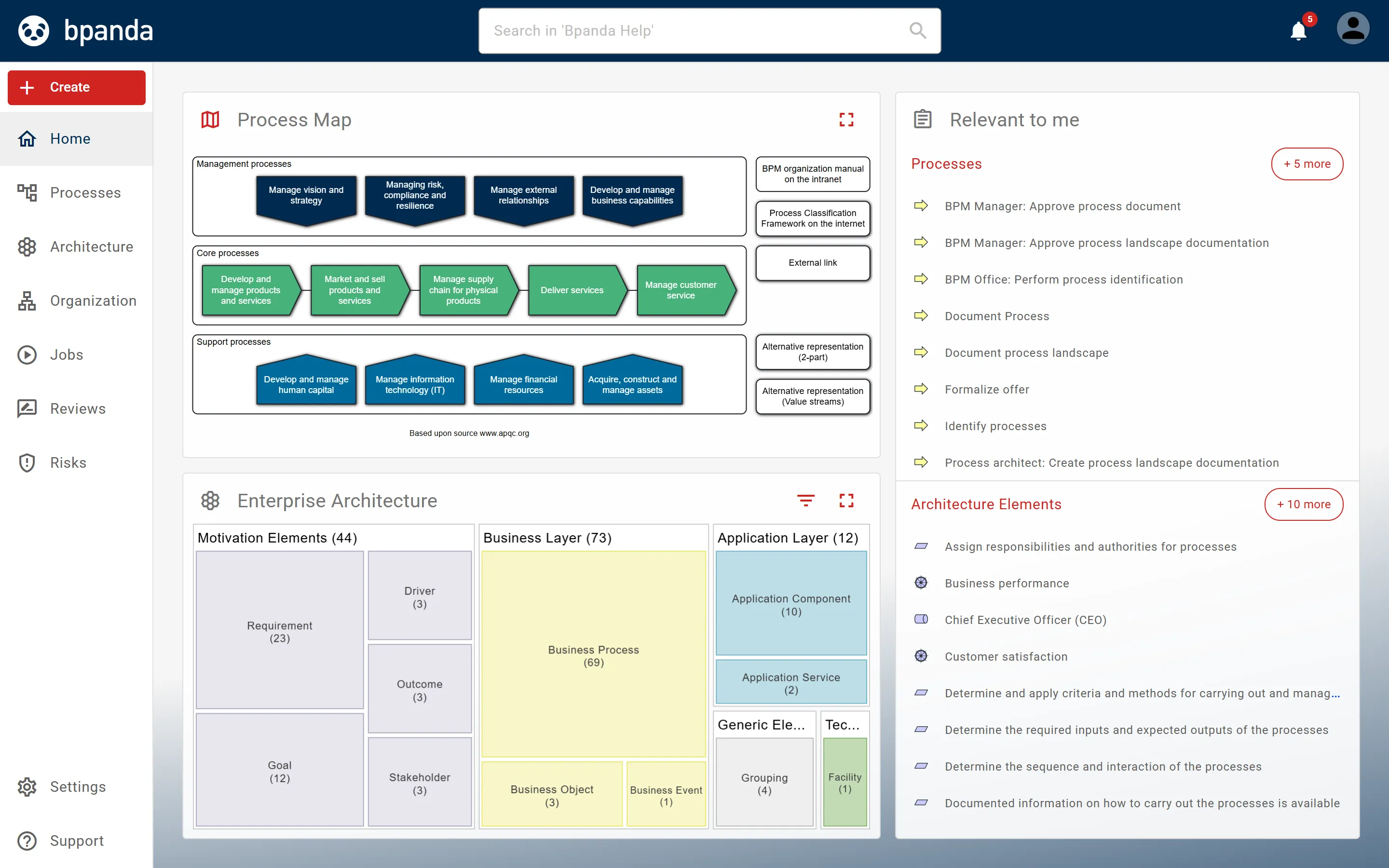
In the middle, the home page shows your process map and, below it, your enterprise architecture. The BPM Manager defines under Settings > Manage Process Space on the Customize tab under Home page view whether only the process map, only the enterprise architecture or both are displayed one below the other.
The Process map tile has a second view: the Process hierarchy displays your process hierarchy as a tile graphic: on the outside the process maps of the topmost level, within them the subordinate ones. Use the icon to the left of the title to switch between the two views; if there is no topmost process map, the tile shows the process hierarchy straight away. In this view, use the filter icon with Show processes to show or hide the processes and use Number of hierarchy levels to define how many levels the graphic shows. When you hover over an area, a preview appears; clicking opens the process map or the process.
The enterprise architecture displays your inventory of published architecture elements as a tile graphic: on the outside the ArchiMate layer, within it the element types, each with their number. Use the filter icon to hide individual element types, and the full screen icon to switch to the Architecture area. Clicking an area takes you to the Published tab, already filtered to the selected layer and the selected type. If there are not yet any published architecture elements in the Process Space, this is stated here — BPM Managers and Designers find the way to create them there. See Architecture.
On the right, the Relevant for me area brings together all the information that concerns you. Each area shows the first entries and, with + n more, the number of remaining ones. Clicking the heading opens the respective page.
- Tasks shows your tasks, e.g. your pending Jobs, risk analyses or the completion of Reviews; the heading opens the My tasks page
- Drafts* shows the drafts you have created and saved in the Modeler
- Processes shows the processes to which you have been assigned as Process Owner, Process Participant or Process Contributor; the heading opens the Relevant processes page
- Architecture elements* shows the architecture elements you are responsible for; the heading opens the Published tab with the I am responsible switch set
- Favorites shows the processes you have marked as a favorite
- Recently viewed shows the content you viewed most recently
The home page also serves as the entry point to the process hierarchy. Starting from the topmost process map, you can reach each of your processes and call up all the functions available to your role. At a particular level of the process hierarchy, a process map graphically displays the hierarchy elements assigned at that level.
Use the enlarge icon to open the Process Hierarchy page. It shows which process maps and processes lie beneath a process map. On the left, you can additionally show the tree of the process hierarchy.
* Role-dependent functions
Main menu
The main menu is permanently visible on the left and is used to call up all the general functions available to you through your role.
The Create button is located above the main menu. Use it to create new content. Which content is offered depends on your role: Architecture for an architecture element, Process for a process draft in the Modeler (where you can also import a BPMN file as a draft), Process map for a new process map.
-
Home calls up the home page with the process map, the enterprise architecture and the information relevant to you
-
Processes opens the process hierarchy. Authorized users choose in the submenu between Process hierarchy and Manage Processes*; the latter provides actions for assigning processes to a process map, for assigning roles for one or more processes and for hiding and showing processes, among others
-
Architecture shows your enterprise architecture: on the Evaluations tab the activated evaluations, on the Published tab all published architecture elements and on the Drafts tab* your elements that have not yet been published
-
Organization shows organizational units and organizational roles and how they are linked to each other and to processes
-
Jobs shows your jobs: the jobs to be taken over, the active ones and the completed ones
-
Reviews* shows the reviews of process revisions to which you have been assigned by the Review Owner
-
Risks* opens the Risk Management page with functions for BPM Managers and Risk Managers for the overview and evaluation of risks and opportunities of the processes
-
Support opens a submenu
- Help calls up this help
- Contact establishes contact with Bpanda Support, e.g. for an error report or your suggestions
- System info shows information about your Bpanda installation, e.g. the version
-
Settings appears for BPM Managers and Account Managers. If you have both roles, it opens a submenu; as a BPM Manager alone it leads directly to Manage Process Space, as an Account Manager alone Manage account takes its place and opens the account administration in a new tab
- Manage Process Space* provides BPM Managers with functions for user administration and for customizing the interface
- Manage account* allows Account Managers to call up the account administration (Customer Accounts for MID Products – CAMP) for the Process Space with the administration of licenses, Account Managers, users and groups, see Manage account (introductory video)
* Role-dependent functions
You reach your tasks, drafts, processes, favorites and recently viewed content not via the main menu, but via the areas on the right of the home page.
User menu
A profile is managed centrally in the account for every Bpanda user. You can change your personal data in your user profile.
You open the user menu at the top right via your profile picture, next to the notifications. Your profile picture, your name and your email address appear above the commands.
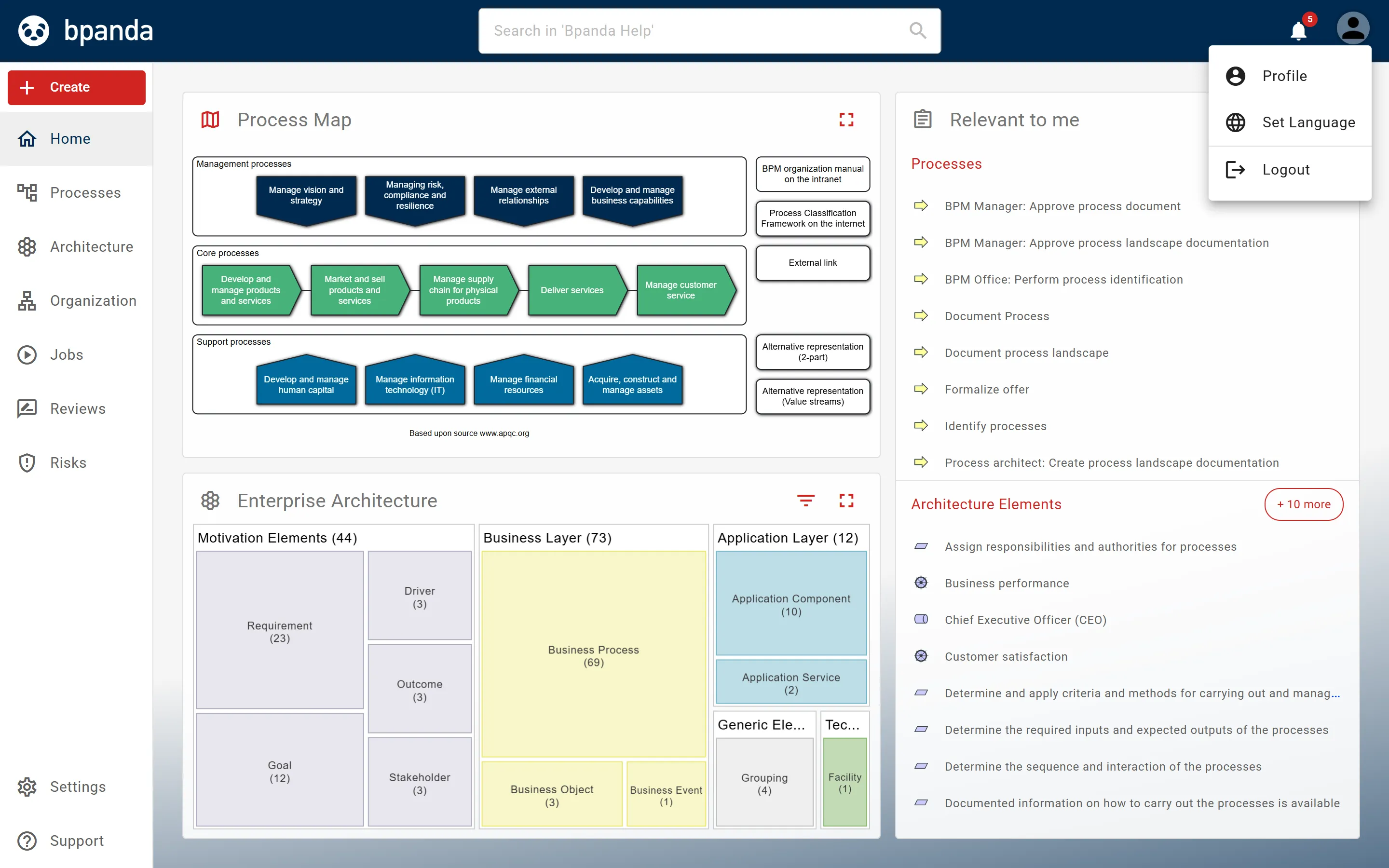
The following commands are available in the user menu:
-
Profile
Shows your name, your email address, your roles and your organizational units. Here you can upload your profile picture. Manage profile opens your account page for the Bpanda login in a new window. There you change personal details such as name and language, and under Account security your password. If name and language come from your company’s user administration (a directory service such as Entra ID), you cannot change them there. The language you choose there is also used by the account administration.
-
Set language
The system language and the content language can be set independently of each other.
The system language is used to display all menu entries, headings, descriptive texts, etc. that belong to the Bpanda user interface and are not related to the process data or other imported data.
Bpanda displays processes, process maps and organizational units in the content language, provided they have been translated. If the translation is missing, Bpanda displays the content in the system language. If that is missing too, it appears in the modeling language of the Process Space. You can only translate content if the Process Space has at least two content languages; otherwise Bpanda hides all the options for translating. Where a name or a description can be translated, the translate icon appears, a character next to an A. Clicking it switches to the two-column view with the source language on the left and the target language on the right. In Google Chrome, this view additionally provides Translate all changed and untranslated texts using local AI. Clicking it translates all texts that are missing in the target language or whose source text has changed since the last translation, using a language model that Chrome runs on your computer. If Chrome first has to download the language model, the button shows a progress circle; if Chrome cannot translate the selected language pair, it remains disabled. The translation is entered in the fields of the target language and is only saved once you confirm the dialog or the editing.
-
Switch Process Space
Only appears if you have access to several Process Spaces. Here you switch the Process Space.
-
Log out
This command logs you out of Bpanda immediately. The login dialog appears.
See also: Getting to know the process hierarchy and organization, Getting to know the process page, Navigating in the Process Space